.jpg)
What Are the Different Parts of a Scaffold

Updated: Jun 15
A scaffold is a temporary structure with an elevated platform to support tradesmen when working at heights. They are comprised of several core components, including screw jacks, standards, ledgers, transoms, braces, planks, and couplers - each playing an important role in supporting workers and distributing loads into the ground.
Our article outlines the essential scaffolding components required in construction and their individual (or collective) functions. We also go in depth on additional components that may be required per project guidelines.
Essential Scaffold Components
Standards
Standards (also known as verticals or uprights) are long vertical supports that transfer the load of the structure, its materials, and tradesmen downwards. They are the backbone of the structure, containing v-pressings (or stars) for ledgers, transoms, braces, and other scaffold accessories to slot into.
Open-end standards are a subset that allows U-heads to slot onto the top, creating a makeshift formwork shoring system. While convenient, the shoring systems’ strength doesn’t match the more traditional H-Frame and V-Frame systems. Open-end standards are a unique product of kwikstage scaffolding.

Ledgers
Ledgers are non-load-bearing horizontal tubes that run the length of the scaffold (parallel to the wall) and connect standards to each other. They also act as handrails for kwikstage, and determine the height at which boards are set. The Scaffright team also use them for handrails at ground level by connecting them to a system of handrail posts.

Transoms
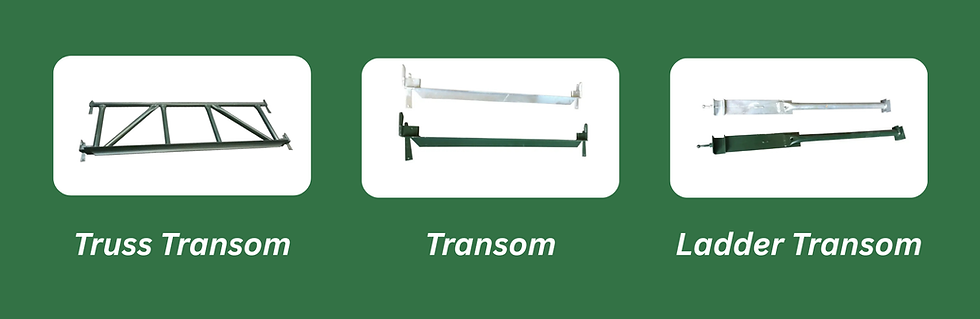
Transoms (also known as bearers) are load-bearing components that sit perpendicular to ledgers and support scaffolding planks. Their purpose is to support both standards and planks and secure the latter in position.
Truss transoms are a heavy-duty alternative that are built for heavy loads and bridging. Ladder transoms support boards but provide an opening for ladders. The size of the ladder access is determined by the size of the bay itself (and the ladder transom).
Braces
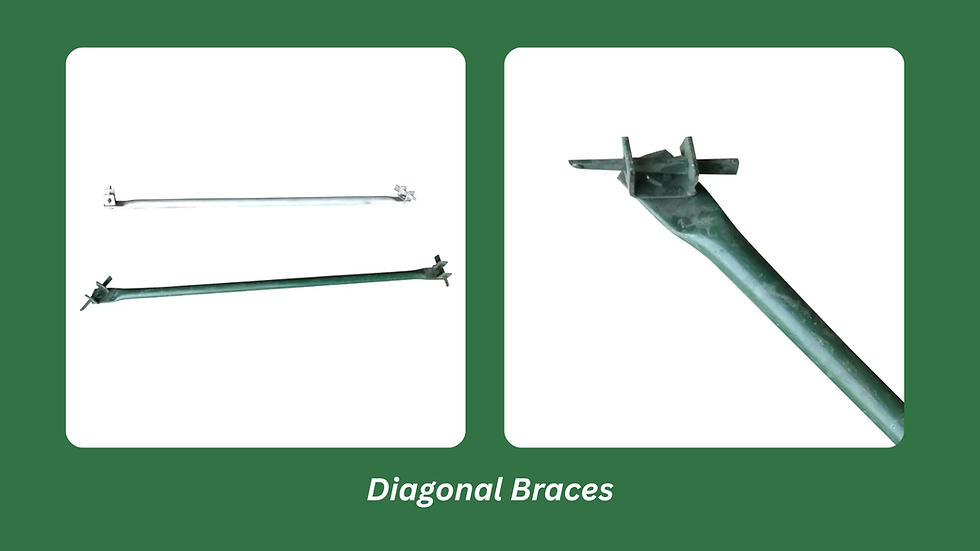
Scaffold braces are diagonal tubes that act as a stabilising influence on the scaffolding. They control the unbraced length of the standards, preventing them from swaying, bowing, or collapsing under heavy loads. The different loads that braces reinforce against can be categorised into three types:
Live Loads: The weight of the people, construction materials, and tools that shift around on the scaffold.
Dead Loads: The weight of the structure itself.
Environmental Loads: Natural elements such as rain, wind, or snow (in colder parts of the world).
Kickboards
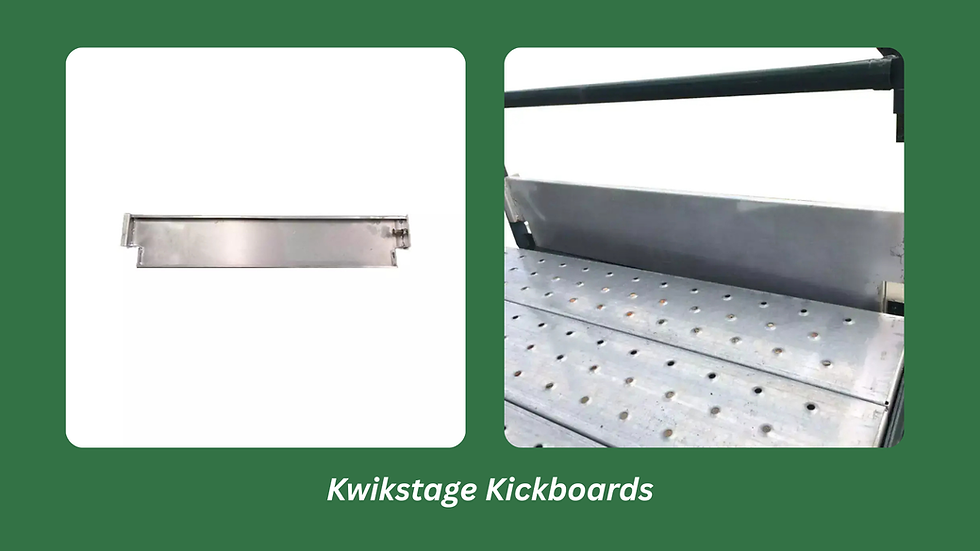
Kickboards (also known as toe boards) are fitted around scaffolding planks to prevent objects from falling off the tower. They are an essential component when materials and equipment are on the system. Toe boards reduce hazards for workers by ensuring that no tools or materials will fall from above and potentially hit them.
Scaffolding Planks
Scaffold planks (also known as decks or boards) are load-bearing platforms that support tradesmen and materials, allowing the former to conduct elevated work. Transoms sit at each end of the planks to hold them in place. Depending on the project, scaffolders may use one of three planks:
Timber Planks: Manufactured using laminated veneer lumber (LVL) that uses thin veneer sheets layered on top of one another and hot-pressed with resin to create a strong platform for scaffolders to work on. Each plank is rated to support 225kg.
Aluminium Planks: These platforms are popular for their inability to rust or rot like their steel or timber counterparts. They are also commonly used on 2-plank and edge protection systems that are widespread on single-storey residential builds. Aluminium planks are rated to support 225kg.
Steel Planks: Ideal for heavy-duty loads, steel planks are rated to support loads of 675kg. Each plank is hot-dipped galvanised, which protects against rust.

Screw Jacks & Sole Boards
Screw Jacks act as the foundation of the scaffold, the flat plates distributing the weight evenly into the ground. The jack component allows the height of the scaffold base to be adjusted, particularly useful when working on uneven terrain.
Sole boards are useful on uneven or soft terrain, with the added surface area distributing weight over a greater area than a regular screw jack. They are important on worksites without a solid ground as they provide additional stability (i.e. grass, soil, sand, and gravel).

Additional Scaffold Components
Couplers
Couplers (also known as clamps, fittings, or clips) connect individual tubes together to create a scaffold structure or support an existing one. They are primarily used on scaffold setups where the tubing acts as standards, ledgers, transoms, and/or bracing. They also work as scaffold accessories, supporting kwikstage systems when additional bracing is required. The table below outlines the functions of different couplers.
Type | Function | Image |
Double Coupler (also known as Right Angle coupler) | Connects scaffold tubes at right angles. For resisting tension/compression loads. |  |
Swivel Coupler (Also known as Swivels) | Couplers connected by a swivel pin, for joining tubes at any angle. |  |
Putlog Hooks | Attach to putlogs or transoms, allowing them to hook over ledgers/tubes securely without additional couplers. |  |
Board Retaining Coupler (Also known as Board Retaining Clip) | Secures boards to transoms or tubes to prevent upward movement. |  |
Hoarding Coupler (Also known as Hoardings) | Attach to the outside of a scaffold bay to hold hoarding boards in place. |  |
Half Coupler | Single-sided fitting to connect tubes to structures or attach accessories. |  |
T-Bolt Coupler | Couplers tightened with a T-head bolt. Used when a high clamping force is required. | |
Fixed Beam Clamp (Also known as Girder Clamp) | Rigid fitting for securing tubes to steelwork at 90° angles. |  |
Swivel Beam Clamp | Adjustable clamp for fitting scaffolds to steelwork, but with a swivel for various angles. |  |
Internal Coupler (Also known as Internal Joint Pin) | Inserted inside two tubes to align and connect them end-to-end. |  |
External Coupler (Also known as External Joint Pin) | A sleeve fitted over the outside of two tubes to connect them together. Stronger than internal pins. |  |
Scaffold Tube
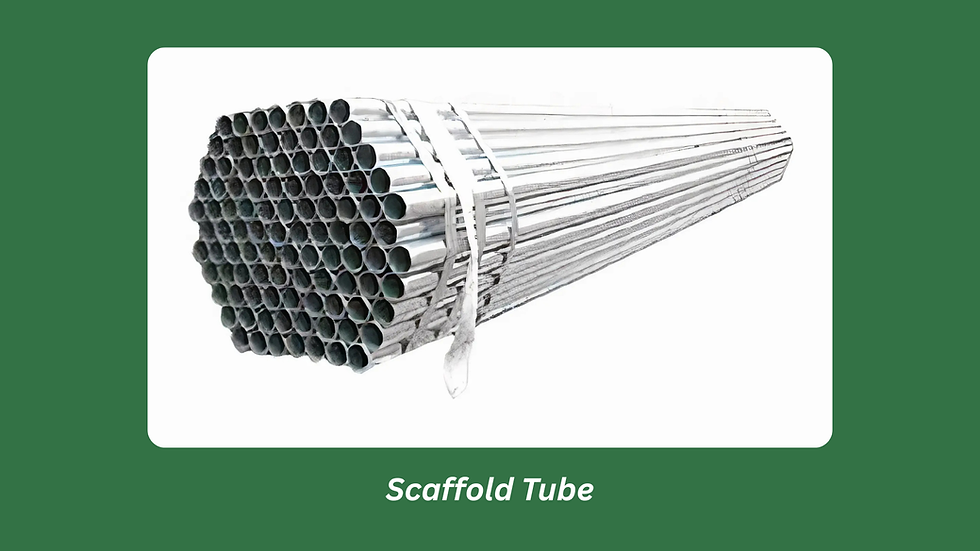
Scaffolding tubes are load-bearing components that can function as standards, ledgers, transoms, and/or bracing. These aluminium and galvanised steel tubes are primarily used in tube and coupler scaffolding, but can help brace and support other scaffolding systems.
Hop-Ups
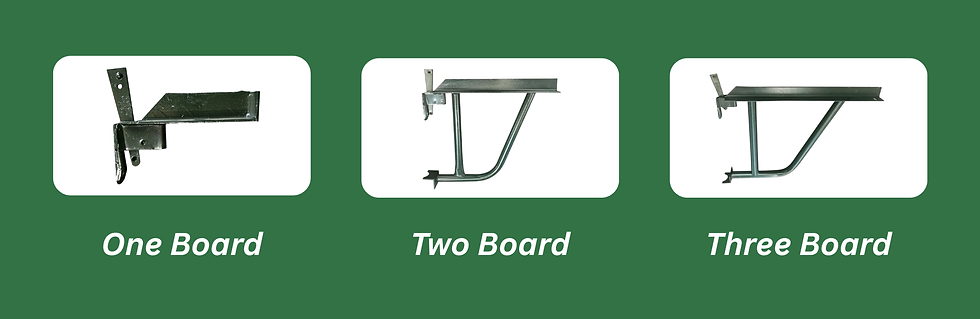
Hop-ups work by allowing scaffolders to extend the width of the bay by one, two, or three planks. Two and three-board hop-ups attach with a cantilever for additional support, meaning they are free to load-bear people, materials, and equipment.
The larger hop-ups that can support two and three planks also have variations with a spigot, enabling scaffolders to attach small standards and ledgers to create guard rails, adding further stability.
Corner Brackets
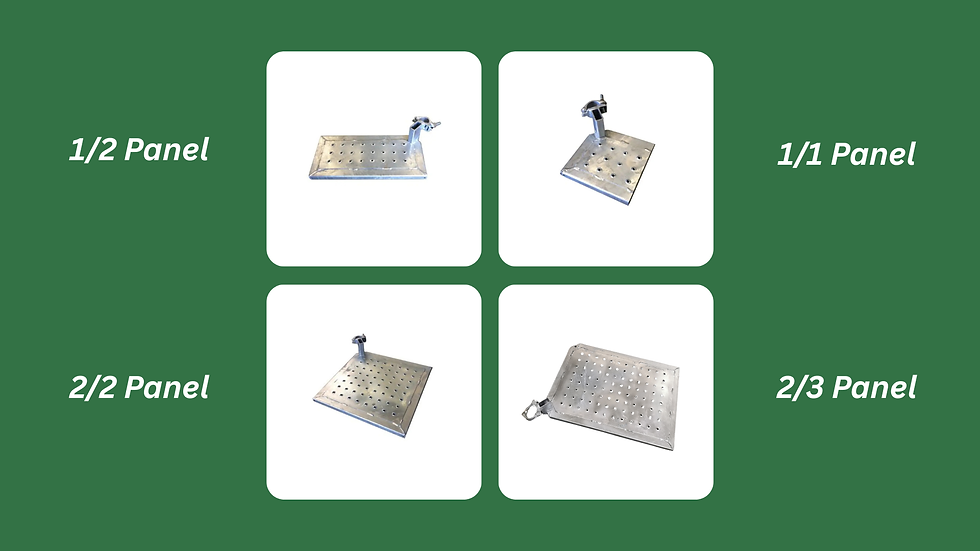
Corner brackets (also known as corner panels) are used in tandem with hop-ups to fill any corner gaps in the scaffold bay. They come in multiple sizes depending on the size of the platforms and the hop-ups used.
Stretcher Stairs
Stretcher stairs sit within access towers to provide workers access between different levels of a scaffold. They come available in sizes ranging between one and two metres to suit different projects. Stretcher stairs require two side-by-side for a safe path up the tower, whereas the one metre stairs are bigger and fit the whole width of the bay.

Shade Cloth
Shade cloth fits along the outside of a scaffold bay, often on large-scale residential and commercial builds, and serves multiple functions:
Obstruct outside viewing of the worksite.
Provide shade and UV protection for workers.
Protect against dust and debris.

Miscellaneous
Type | Function | Image |
Toe Board Clip (Also known as Champagnes) | Attach to the outside of standards, providing a fitting for kickboards to slot across the length of the scaffold bay |  |
End Toe Board Clip | Attach to the outside of standards, providing a fitting for kickboards to slot into on the narrow width of the scaffold bay |  |
Double C Clip | Attach two standards back-to-back for additional stability |  |
Base Plate | Similar to a screw jack, it sits at the base of the scaffold. |  |
Single Wall Tie Bracket (Also known as Wall Ties) | A bracket with a single coupler that secures a scaffold bay to an external structure (Note: Due to changes in Australian standards, these components are no longer compliant) |  |
Double Wall Tie Bracket | A bracket with two couplers that secures a scaffold bay to an external structure |  |
If you require more information about certain scaffolding components or want to get started on your next project, call 1300 783 336.